
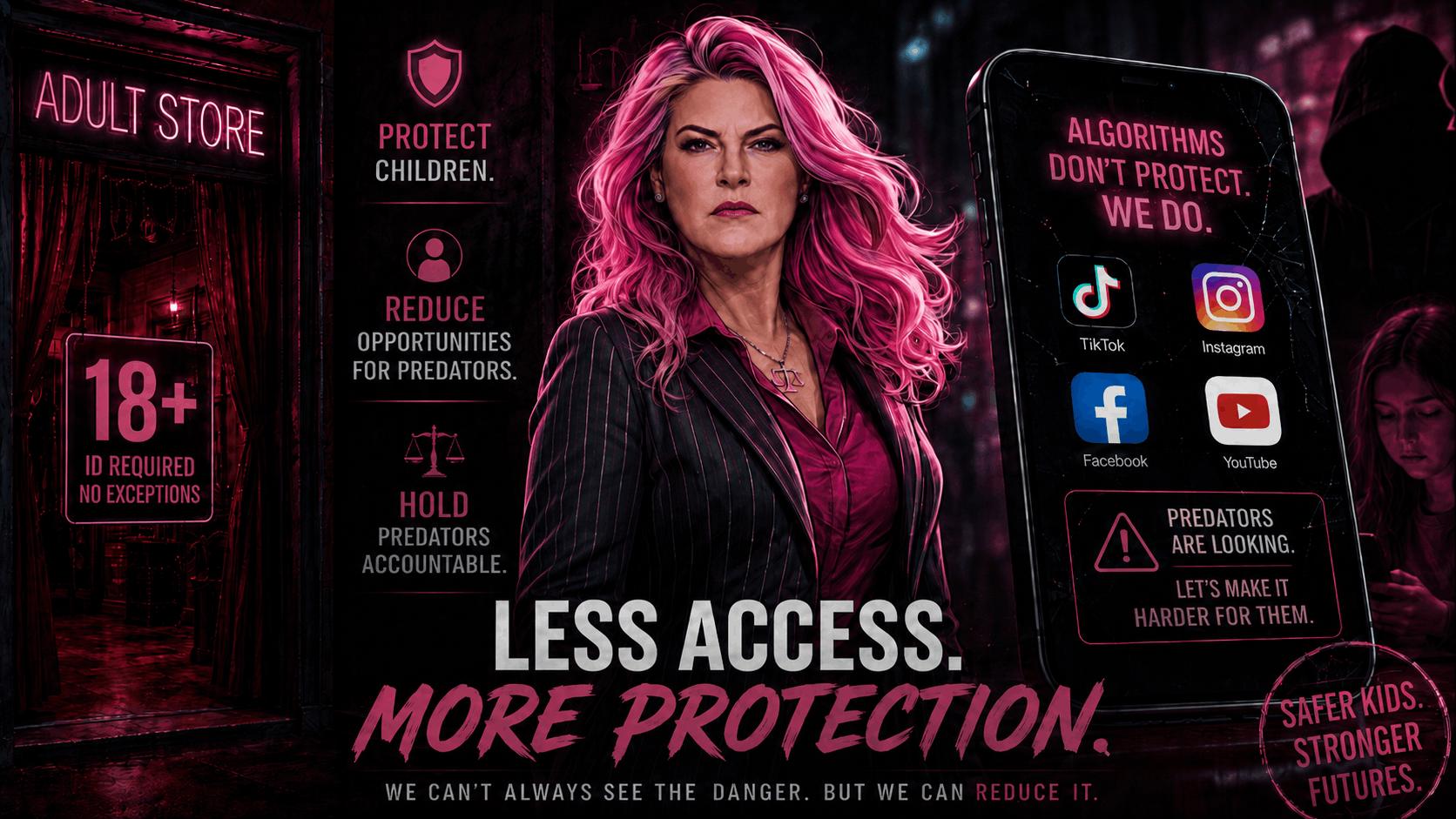
Adult stores already keep kids out, and Marlo Greer argues social media should do more of the same. Restricting children’s access to social media reduces the number of targets available to predators.
An online commenter asked Marlo whether adult stores, the ones selling explicit magazines, videos and sex-related merchandise, should be shut down because “parents can’t keep kids out of them.” Marlo responded in a recent video. She notes that the question was really prompted by efforts to regulate children’s access to adult content on the internet.
First, Marlo points out that adult stores typically have protections in place to keep children out. Most require patrons to be 18 or older, and most are good about enforcing that, because if they don’t, the local community can make life very difficult for the owner.
Age Limits for Kids on Social Media
People are asking for similar rules for social media. As Marlo notes, some countries won’t let children use social media at all. Australia, for example, bars minors under 16 from platforms such as TikTok, Instagram and Facebook. Other countries, including Denmark, France, Germany and Spain, have either recently passed or introduced legislation that would impose similar restrictions on younger users.
For an overview of the U.S. debate and lawsuits, read Social Media Age Restrictions and Child Safety.
Access Controls and Online Child Safety
As Marlo says, this goes beyond punishing the predator who sees a child on social media as a target and uses it to connect with that child. Focusing only on criminal predators has been tried for decades and has limits. The Catholic Church’s historical practice of protecting predator priests by moving them around after accusations is a clear example of the problem with focusing only on the predators.
The comparison between adult stores and social media has a limit. The algorithms make social media addictive for children, and for everybody. That means children will be available on social media as targets.
Restricting children’s use of social media reduces the number of targets available to predators. Even if restrictions don’t keep every child off social media, they will keep some off, which makes it harder for predators to find targets. Combined with strict enforcement against predators, that will help reduce the number of children who become victims.
For more on the lawsuits, read Social Media Harm Lawsuits: What Parents Need to Know.
Compensation for Sexual Assault Survivors
Greer Law Group represents clients who have survived sexual assault. If you or your child was targeted by a sexual predator or suffered a sexual assault, you may be able to recover compensation from those responsible. That can include the predator who committed the attack and organizations or corporations that may have helped it happen.
We understand that deciding to sue over a sexual assault that you or your child survived is not easy. We never pressure a client into that decision. We’ll give you the information you need to understand the process and answer your questions, so you can decide when you are ready.
Call Greer Law Group at 303-331-6460 or fill out our contact form for a free case evaluation.