

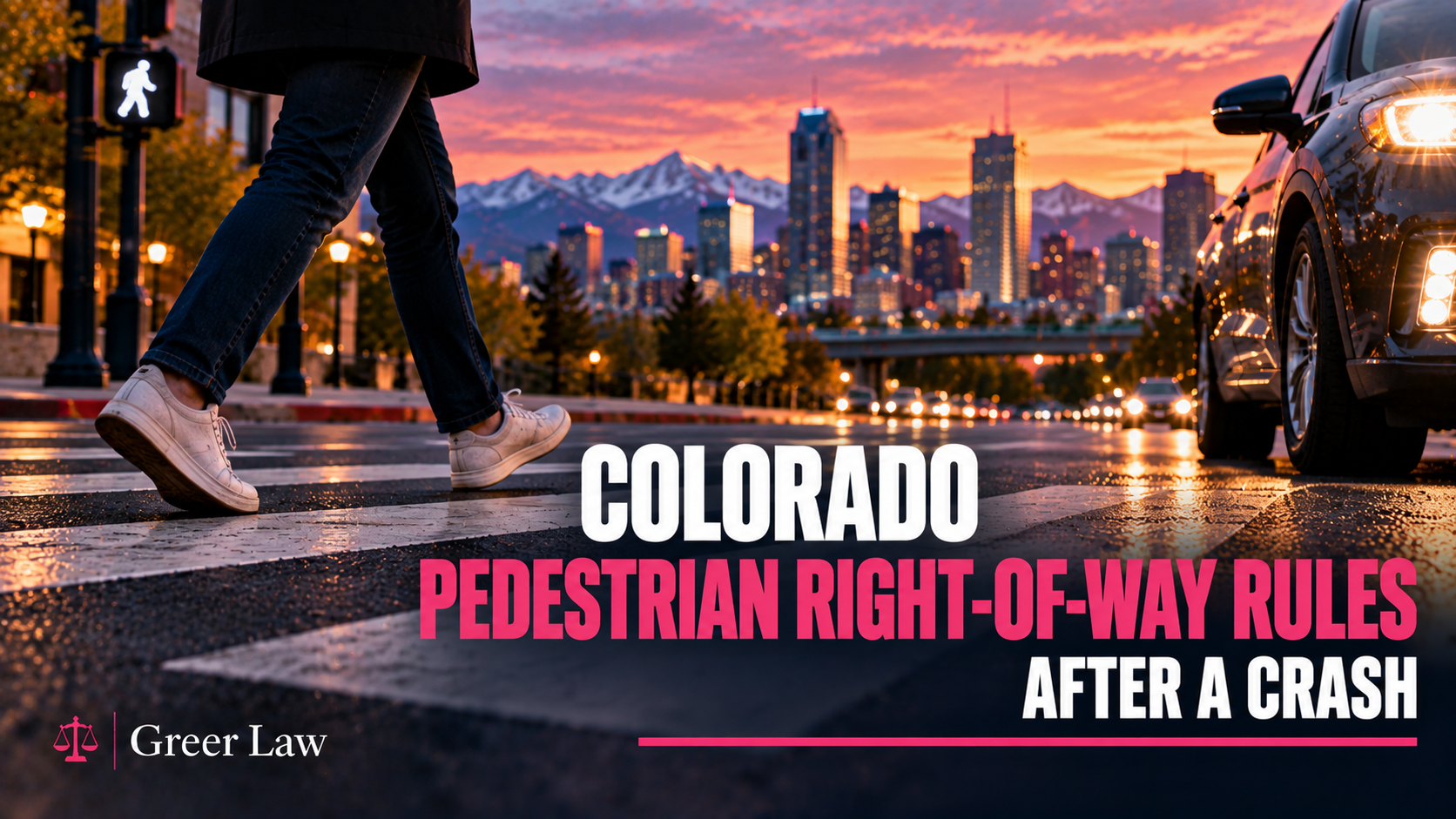
A person on foot has almost no protection when a vehicle hits them, and these crashes can cause serious or permanent injuries. After a pedestrian crash, fault often turns on Colorado’s right-of-way rules and on whether the driver used the care the law requires. Here are rules that often come up.
When Drivers Must Yield in a Crosswalk
Where traffic signals are not in place or not working, a driver must yield to a pedestrian crossing the road within a crosswalk, slowing down or stopping if needed, when the pedestrian is on the driver’s half of the road or is approaching so closely from the other half as to be in danger (C.R.S. 42-4-802(1)).
When a vehicle has stopped at a marked crosswalk, or at an unmarked crosswalk at an intersection, to let a pedestrian cross, a driver coming from behind may not pass that stopped vehicle (C.R.S. 42-4-802(4)).
Pedestrians Cannot Step Suddenly Into Traffic
A pedestrian may not suddenly leave a curb or other place of safety and walk or run into the path of a moving vehicle that is so close it is an immediate hazard (C.R.S. 42-4-802(3)).
Crossing Outside a Crosswalk
A pedestrian crossing a road anywhere other than a marked crosswalk, or an unmarked crosswalk at an intersection, must yield the right-of-way to all vehicles on the road (C.R.S. 42-4-803(1)). Between two neighboring intersections that both have working traffic signals, pedestrians may cross only in a marked crosswalk (C.R.S. 42-4-803(3)).
Walking Where There Is No Sidewalk
Where there is no sidewalk, pedestrians must walk on the shoulder as far as practicable from the edge of the road. Where there is neither a sidewalk nor a shoulder, they must walk as near as practicable to the outside edge of the road, and on a two-way road, on the left side facing oncoming traffic (C.R.S. 42-4-805(1)).
Drivers Must Still Use Due Care
Even when a pedestrian did not have the right-of-way, Colorado law requires every driver to use due care to avoid hitting a pedestrian, to sound the horn when necessary, and to take proper precautions on seeing a child or an obviously confused or incapacitated person in the road (C.R.S. 42-4-807).
Shared Fault
A pedestrian who was partly at fault can still recover, as long as the pedestrian’s share of fault is less than the fault of the party being sued. The award is reduced by the pedestrian’s percentage of fault (C.R.S. 13-21-111).
Deadlines to File
Most injury claims from being hit by a car or other motor vehicle must be filed within three years (C.R.S. 13-80-101(1)(n)). If a government vehicle or employee was involved, a written notice of claim is generally due within 182 days of discovering the injury, and missing it can bar the claim (C.R.S. 24-10-109). A wrongful death claim generally must be filed within two years of the date of death (C.R.S. 13-80-102(1)(d) and 13-80-108(2)).
You can read more on our Colorado pedestrian accident page.
Talk With Marlo Greer
If you were seriously or permanently injured when a vehicle hit you, Marlo Greer and the team at Greer Law Group can look at what happened and who is responsible. Call our Denver office at 303-331-6460.