

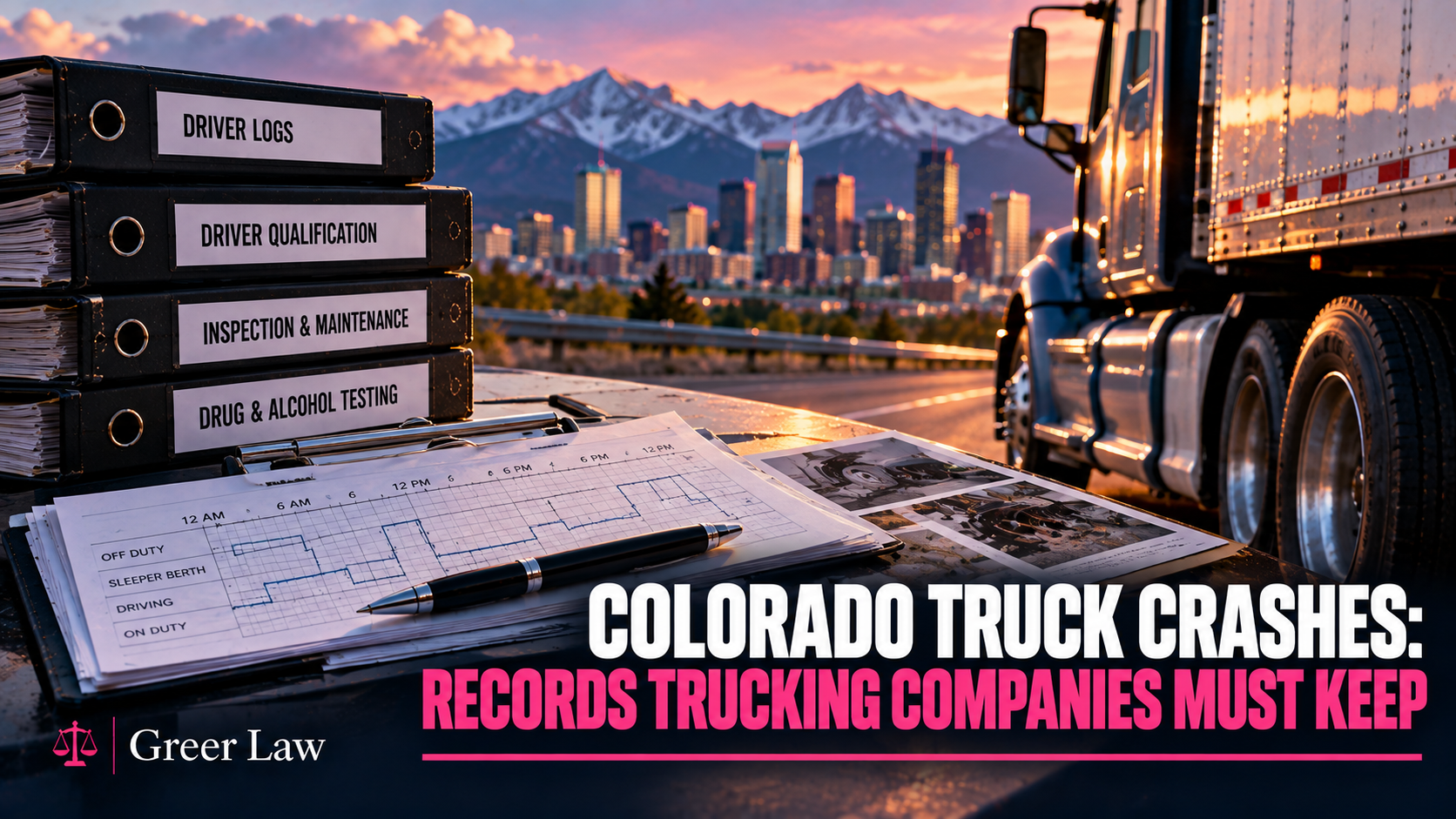
After a crash with a semi or other commercial truck, much of the important evidence can be in the trucking company’s files, not at the scene. Federal rules require carriers to keep many of those records, but some only have to be kept for a few months. Knowing what exists, and how long it must be kept, can matter in a Colorado truck crash claim.
Driver Logs and Hours of Service Records
Interstate truck drivers who are required to keep records of their driving and on-duty time generally must use an electronic logging device, known as an ELD. There are exceptions, including certain short-haul drivers, drivers required to keep logs on no more than 8 days in any 30-day period, certain drive-away and tow-away operations, and vehicles with a model year before 2000 (49 C.F.R. 395.8 and 395.1(e)).
Those logs show whether the driver followed federal hours of service rules. Drivers of property-carrying trucks may drive a maximum of 11 hours after 10 consecutive hours off duty, and generally must take a 30-minute break after 8 cumulative hours of driving (49 C.F.R. 395.3). When adverse driving conditions keep a driver from safely completing the run, the driving limit can be extended by up to 2 hours (49 C.F.R. 395.1(b)(1)).
Carriers must keep records of duty status and supporting documents for at least six months (49 C.F.R. 395.8(k)(1)).
The Driver Qualification File
A trucking company must keep a driver qualification file for each driver it employs (49 C.F.R. 391.51). The file includes the driver’s employment application, the driving record from each state where the driver held a license, a road test certificate or its equivalent, annual driving record reviews, and the medical examiner’s certificate.
The file generally must be kept while the driver works for the company and for three years afterward, though the annual driving record checks, annual reviews and medical certificates can be removed three years after they were created. This file can show whether the company checked the driver’s history before putting that driver on the road.
Inspection and Maintenance Records
Carriers must systematically inspect, repair and maintain the vehicles they control (49 C.F.R. 396.3). For vehicles a carrier controls for 30 days or more, the maintenance records must be kept for one year, and for six months after the vehicle leaves the carrier’s control.
Drivers must also complete an end-of-day inspection report when they find or are told of a defect. The carrier must keep each report, the certification of any repairs, and the certification of the driver’s review for three months from the date the report was prepared (49 C.F.R. 396.11). That is one of the shortest retention periods for trucking records.
Post-Crash Drug and Alcohol Testing
Federal rules require the employer of a commercial driver to test the driver for alcohol and controlled substances as soon as practicable after certain crashes (49 C.F.R. 382.303). Testing is required when the crash involved a death. It is also required when the driver was cited for a moving violation within 8 hours (for alcohol) or 32 hours (for drugs) and someone was injured and immediately treated away from the scene, or a vehicle was disabled and had to be towed.
Attempts at alcohol testing stop after 8 hours, and attempts at drug testing stop after 32 hours. If a required test was not done, the company must keep a written record explaining why.
Insurance Minimums for Commercial Trucks
For-hire carriers hauling nonhazardous property across state lines in vehicles of 10,001 pounds or more must carry at least $750,000 in financial responsibility. The minimum rises to $1,000,000 for oil and certain hazardous materials and $5,000,000 for certain other hazardous materials, and those higher limits also apply to private carriers and, in some cases, to trucks that stay within one state (49 C.F.R. 387.9). These are minimums, and a carrier’s actual coverage can be higher.
Colorado Deadlines and Shared Fault
In Colorado, most injury claims from a truck crash must be filed within three years (C.R.S. 13-80-101(1)(n)). A wrongful death claim generally must be filed within two years of the date of death (C.R.S. 13-80-102(1)(d) and 13-80-108(2)).
You can still recover if you were partly at fault, as long as your share of fault is less than the fault of the party you are suing. Your award is reduced by your percentage of fault (C.R.S. 13-21-111).
What You Can Do Now
Keep your photos, the names of any witnesses, the police report number, and your medical records. The sooner a lawyer knows about the crash, the sooner a request can go to the trucking company asking it to preserve its logs, files and inspection reports before the retention periods run out.
You can read more on our Colorado truck accident page.
Talk With Marlo Greer
If you were seriously or permanently injured in a crash with a commercial truck, Marlo Greer and the team at Greer Law Group can look at what records exist and what they show. Call our Denver office at 303-331-6460.