
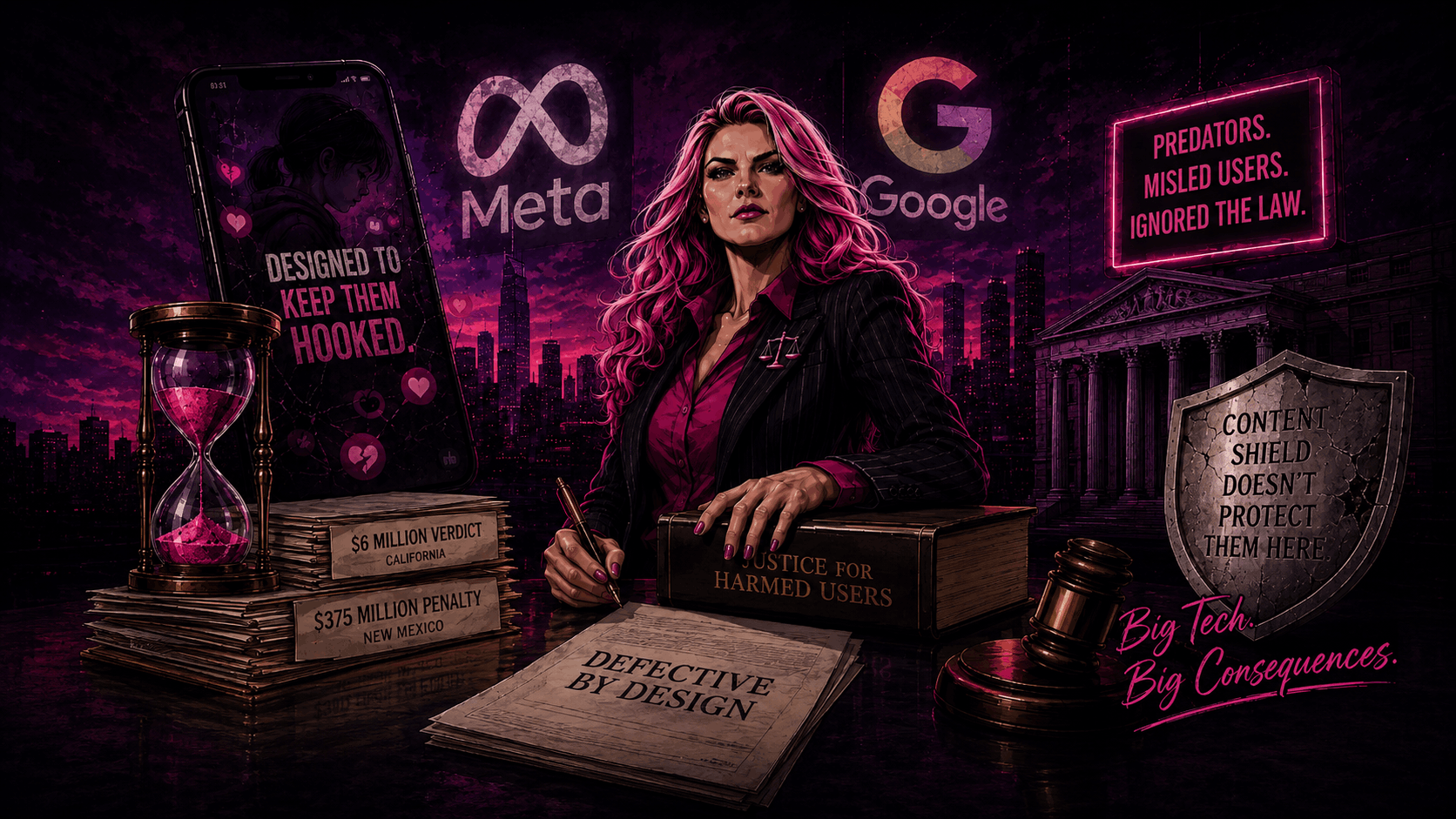
The Meta and YouTube verdicts came from two 2026 cases that found Meta liable for different reasons. A California jury awarded $6 million to a plaintiff who said Meta and Google designed their platforms to be addictive. A New Mexico jury found Meta violated the state’s consumer-protection law, and the penalties in that case now total $942 million.
As Marlo Greer points out in her video, the California case was essentially an argument that the platforms were defective, like defective products that harm someone using them as intended.
The Meta and YouTube Verdicts at a Glance
| California | New Mexico | |
|---|---|---|
| Who sued | A plaintiff who used the platforms as a child | The state of New Mexico |
| Companies | Meta (Instagram) and Google (YouTube) | Meta (Facebook and Instagram) |
| What was at issue | Platforms designed to be addictive, harming her mental health | False or misleading safety statements and unconscionable trade practices |
| Result | $6 million in damages (March 2026) | $375 million in jury penalties (March 2026), plus $567 million ordered by the judge (August 2026) |
| Source | NPR | NPR and PBS |
Deliberately Designed to Be Addictive
In California, the plaintiff argued that Meta and Google were responsible for the depression and anxiety she suffered as a child. Her lawyers argued that Meta’s Instagram and Google’s YouTube were designed to be addictive, and that each company knew its platform was hurting younger users. One particularly compelling piece of evidence was an internal Meta document that declared, “If we wanna win big with teens, we must bring them in as tweens.” Another Meta document discussed the likelihood that 11-year-old users would keep coming back to Instagram, even though the platform supposedly required users to be at least 13.
Overcoming the Content Shield
Federal law largely protects social media platforms from responsibility for the content users post. In California, the case focused on how Meta and Google built their platforms rather than on the content they carried.
As Marlo notes, it was like a defective product case. The platforms, not their content, were on trial, and their deliberately addictive design created the liability for each company. For more on this theory, read Social Media Product Liability: Why Platform Design Matters.
The New Mexico Consumer-Protection Case
In New Mexico, the jury found that Meta had made false or misleading statements about the safety of its platforms. It also found that Meta engaged in “unconscionable” trade practices that took advantage of the vulnerability and inexperience of its child users. The jury awarded $5,000 for each violation, for a total of $375 million in penalties.
In August 2026, the judge ordered Meta to pay another $567 million, bringing the total to $942 million, along with court-supervised changes. Meta has said it will appeal.
New Mexico isn’t the only state where Meta has faced lawsuits over the addictiveness of its platforms for young users. More than 40 state attorneys general filed similar lawsuits, and in August 2026 Meta settled the multistate case for about $12 billion over 10 years, which could rise to about $17 billion if other platforms adopt similar reforms. Read Meta Social Media Addiction Lawsuit: Trial Ends in Settlement and Social Media Harm Lawsuits: What Parents Need to Know.
If Addictive Social Media Harmed You
We help people harmed because of someone else’s negligent or intentional actions, including actions that happen online. If you were hurt mentally or physically because of an addictive platform, or because someone used social media to contact and abuse you, talk to us. That includes mental health issues, sexual abuse or physical abuse connected with social media use.
Call Greer Law at 303-331-6460 or submit our contact form to schedule a free case evaluation.